
Nov 2026
/
6 min read
Can Perfect Pitch Be Trained? From Single Notes to Chords
Can adults learn perfect pitch? Explore the research, practice single notes and chords in Training mode, and stay motivated with competition and leaderboards.
Can perfect pitch be trained? Research shows that some adults can learn to identify notes without a reference, sometimes reaching very high accuracy. That does not mean everyone will develop perfect pitch, or that an app can promise it. It does mean that “you either have it or you don’t” is too simple an answer.
For a practical starting point, work on recognizing one note before moving to chords. Our Perfect Pitch ear-training app for iPhone gives you Training mode for focused listening and competition with Game Center leaderboards when you want a challenge. We make the app; the research below concerns pitch learning, not a clinical or scientific evaluation of our product.
Perfect pitch, relative pitch, and chord recognition
Perfect pitch, also called absolute pitch, means identifying a musical note without hearing a reference note first. If someone plays F-sharp and you name it directly, that is an absolute-pitch task.
Relative pitch means hearing relationships between notes. If you hear a reference C and recognize that the next note is a fifth above it, you are using relative pitch. Matching a note with your voice after hearing it is another distinct task.
Chord recognition adds a different challenge: several notes sound together. Recognizing a major or minor chord quality does not, by itself, demonstrate perfect pitch. You can work on useful harmonic listening without being able to name every isolated note.
These distinctions matter when you choose a practice goal. “Recognize more notes accurately” and “tell chord qualities apart” are clearer targets than simply “get perfect pitch.”
What research says about learning perfect pitch as an adult
A 2019 study by Van Hedger, Heald, and Nusbaum found that some adults reached performance comparable to established absolute-pitch possessors after eight weeks of training. Most participants, however, made only modest improvements. The strongest learner retained the ability at a follow-up at least four months later.
A 2025 study by Wong and colleagues also reported improvements in adult absolute-pitch judgments after training. Transfer to an unfamiliar instrument sound was partial—a useful reminder that success with one sound does not automatically mean equal success with every instrument.
The encouraging conclusion is that adult pitch learning is possible. The realistic limit is that outcomes differ, and these studies do not establish a guaranteed timeline or validate a particular commercial app. Treat training as a way to develop and test your listening rather than a promise of a rare ability.
Start with single notes in Training mode
Perfect Pitch’s Training mode gives you a place to focus before chasing a score. Begin with a manageable selection of notes and listen for the sound itself before choosing an answer.
Try this approach:
- Listen to the note and commit to an answer before checking the result.
- Review mistakes carefully. Replay the sound when available and connect what you hear with the correct note name.
- Keep the task manageable until your answers become more consistent.
- Expand the challenge gradually rather than changing everything after one good session.
For example, if two note names keep getting confused, make distinguishing those sounds your next practice goal. A correct guess is useful feedback, but repeated accuracy across separate sessions tells you more.
When you use another note as a reference, that is still valuable ear training. Just distinguish that result from identifying a note without a reference.
Move from single notes to chords
Once you are comfortable working with individual pitches, bring chords into your training. Perfect Pitch supports chord practice, and Chord Guess lets you listen to several notes together and choose the chord you recognize.
Start by paying attention to the whole sound. Compare the available chord choices, listen again when needed, and notice which ones you confuse. Then return to focused training on those distinctions before another game.
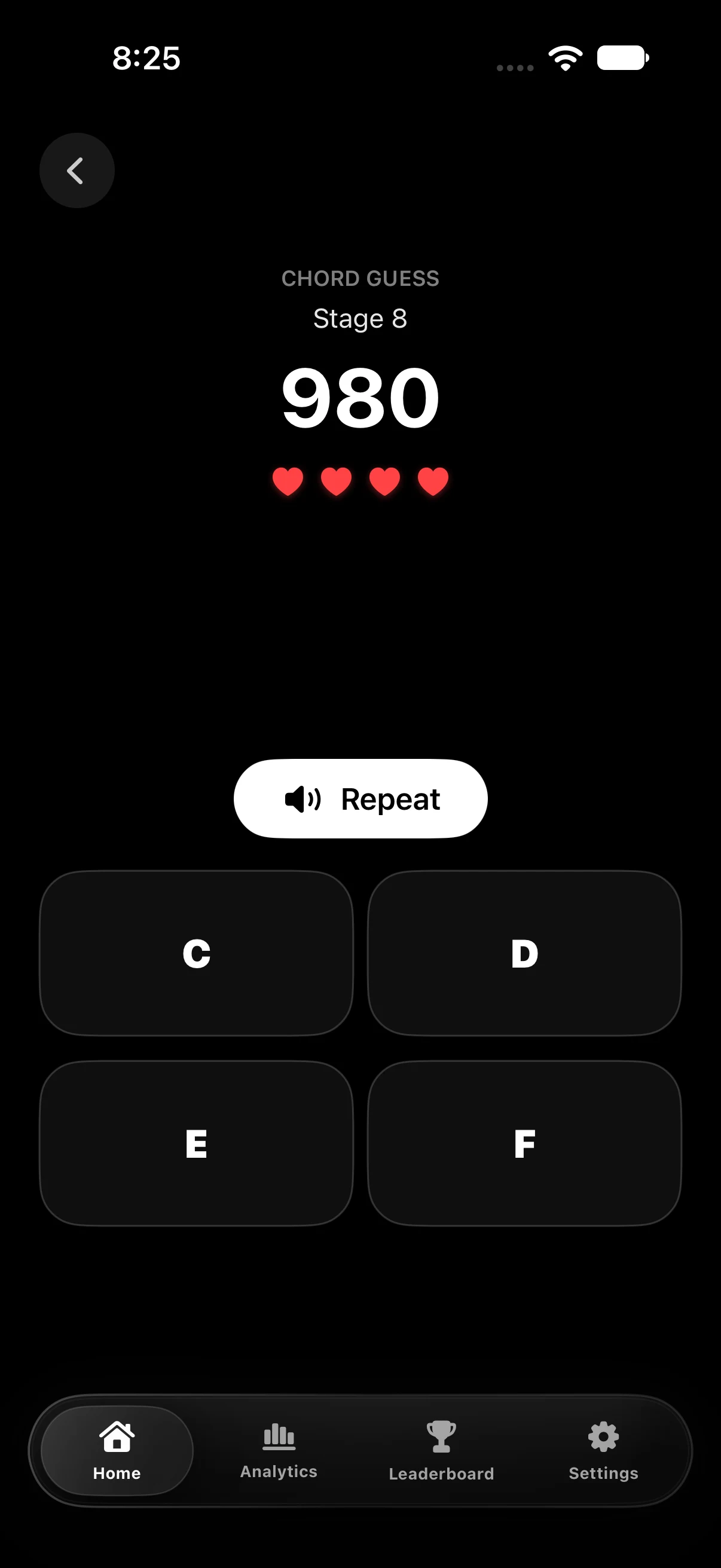
For instance, hearing the difference between a major and minor chord is a useful goal in its own right. Naming the root and identifying the chord quality are separate parts of the task; notice which part needs work. You do not have to master absolute pitch before exploring harmony.
Use competition and the leaderboard to keep coming back
Training mode is where you can slow down and focus. Competition adds a reason to put that practice to the test. In Perfect Pitch, games such as Note Survivor turn listening into a score challenge, with Game Center leaderboards that let you see how you compare with other players.
If competition motivates you, choose a reachable next target: beat your previous score, close the gap to a nearby player, or complete another session with fewer mistakes. Seeing other players on the leaderboard can make a solitary exercise feel like a shared challenge.
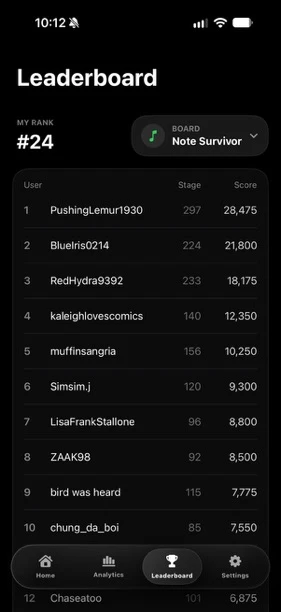
The Note Survivor leaderboard shows your rank alongside other players, with the stage and score for each entry. Use it to find your next target and give your training a competitive goal. Rankings shown are from this screenshot and change as people play.
Use the leaderboard as motivation, not as a test that certifies perfect pitch. Game scores and listening skills are related but different measures. Return to Training mode when speed starts turning your answers into guesses.
A useful loop is simple: practice a weak area, play a competition round, review what was difficult, and use that to choose your next training session.
How can you tell whether your listening is improving?
Compare sessions with similar settings. Look at accuracy as well as speed, and separate single-note results from chord results. Perfect Pitch’s analytics distinguishes game and training activity, giving you a way to review your practice.
You can also check your learning away from the game. Ask someone to play notes on another instrument, or compare chords at a keyboard. Keep track of whether you needed a reference note. Difficulty outside a familiar exercise is useful information about what to practice next.
For a structured session, use our 10-minute pitch-training routine. If your goal includes singing, try these beginner exercises for singing on pitch.
Start training your ear today
You do not need to settle the perfect-pitch question before taking your first step. Start with single notes in Training mode, explore chords as your confidence grows, and use competition and the leaderboard when a challenge helps you stay engaged.
Explore Perfect Pitch’s training features or download Perfect Pitch - Game on the App Store. It is free to start, with optional Premium. Your next goal can be small: listen more carefully, recognize one more sound, and come back tomorrow.