
May 2026
/
4 min read
How to Improve Perfect Pitch by Training
A practical guide to building pitch recognition with simple notes, gradual difficulty, and gamified ear training.
Perfect pitch is the ability to recognize or produce a musical note without needing a reference note. Some people develop it early, but ear training can still make note recognition sharper, faster, and more useful for real music.
The goal is not only to memorize note names. The goal is to build a stronger connection between what you hear, what you understand, and how quickly you can respond.
Start with one note at a time
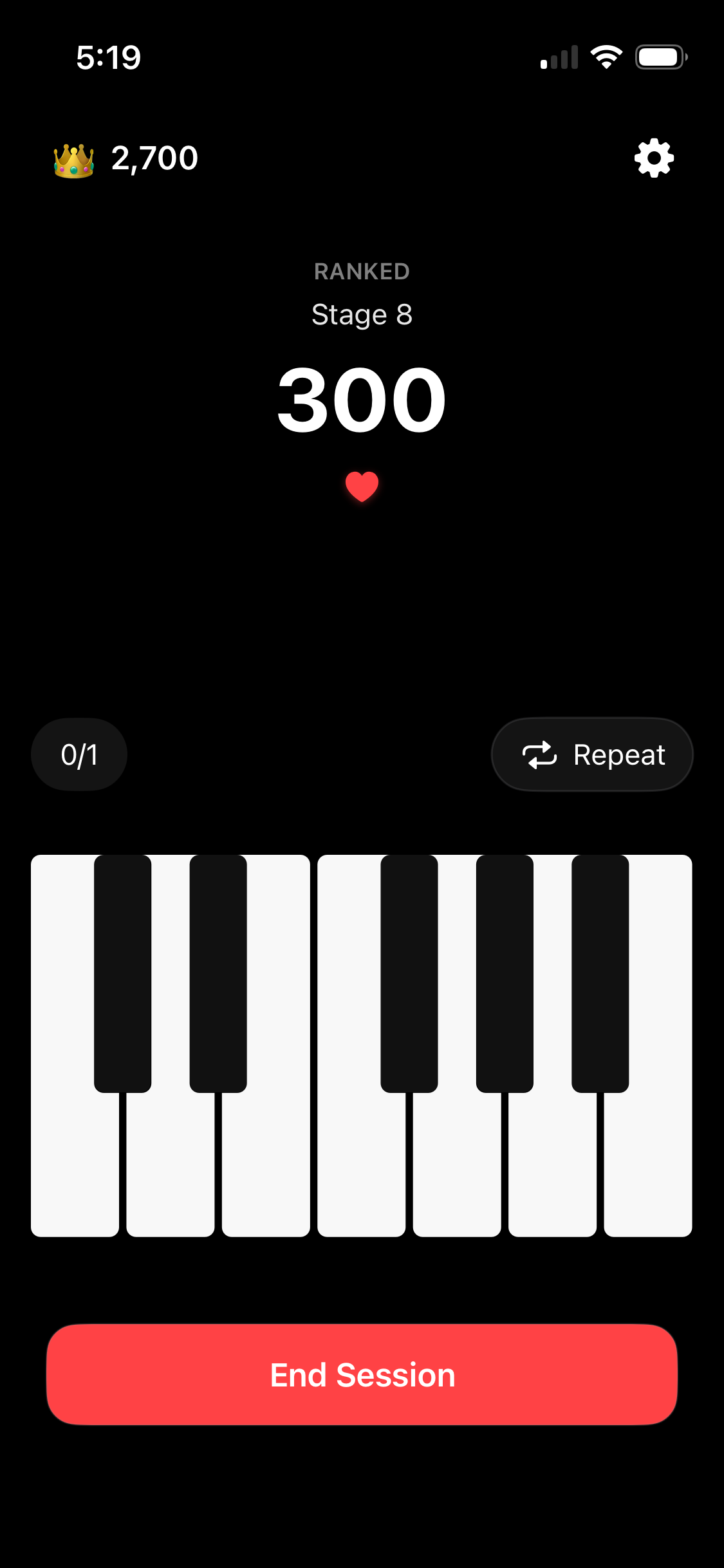
The best way to improve pitch recognition is to remove unnecessary complexity at the beginning. A single note gives your ear one clear target. You can focus on the color of the note, the feeling of its pitch, and the name that belongs to it.
Short, repeated sessions work better than long unfocused sessions. A few minutes every day can help your brain build a reliable pitch memory.
Use the reference song method
One practical way to remember pitches is to connect them with songs you already know. Your brain is very good at recalling familiar melodies, so the first note of a song can become a mental reference point.
Create a small repertoire of 5 to 12 songs that you know by heart. Then use an instrument or tuner to identify the exact starting pitch of each song. For example, one song might help you remember A, another might help you remember C, and another might help you remember G.
After that, test yourself in reverse. When you hear a note, try to identify it without thinking of the song first. Then use your reference song to verify your answer. Over time, the note itself can become more recognizable without needing the song as much.
Practice daily pitch matching
Pitch matching connects your ear to your voice. Play a random note on an instrument or piano app, listen closely, then sing the note back as accurately as possible.
The important part is exact intonation. Try not to slide up or down until you find the note. Listen first, imagine the sound internally, then sing it directly.
Recording yourself can help because it reveals whether you are landing on the pitch cleanly or adjusting after the fact. This kind of feedback is simple, but it can make your practice much more honest.
Use ear training software consistently
Ear training works best when it becomes a habit. Dedicated software or apps can give you structured listening drills for single notes, intervals, and chords.
You do not need a long session. Ten to fifteen minutes a day is enough for meaningful progress if the practice is focused. The key is repetition, feedback, and gradual difficulty.
Train recognition before speed
Accuracy should come before speed. When you are learning, take time to listen carefully and answer with intention. If you rush too early, you may train guessing instead of recognition.
Once single notes feel familiar, speed becomes useful. Time pressure helps you practice the kind of quick listening needed in real musical situations, where notes and chords do not wait for you.
Move from simple notes to harder sounds
After single-note practice, the next step is to increase difficulty gradually. Multiple notes, intervals, and chords require your ear to separate sounds and identify relationships.
This progression matters. Jumping directly into complex chords can be frustrating, but moving step by step helps your ear adapt naturally.
Perfect pitch and relative pitch both matter
Perfect pitch is impressive because it lets you identify individual notes without a reference. But relative pitch is often more practical for musicians because it helps you hear the distance between notes.
Relative pitch is essential for playing by ear, improvising, transposing, recognizing chord movement, and understanding melodies in context. For most musicians, the strongest ear training routine includes both absolute pitch practice and relative pitch practice.
If you play an instrument or sing, think about your goal. A vocalist might focus on pitch matching and intervals. A pianist might practice single notes, chords, and harmonic movement. A guitarist might focus on intervals, chord qualities, and fretboard recognition.
The best routine is the one you can repeat every day.
Why gamification helps ear training
Ear training can become repetitive. Gamification makes practice easier to return to because progress feels visible and sessions feel more active.
Scores, stages, time limits, and leaderboards create feedback. They give you a reason to try again, improve your accuracy, and push for a better result.
How Perfect Pitch - Game helps
Perfect Pitch - Game is designed around this training path. It starts with an easy single-note stage, then moves toward more complicated multi-note and chord challenges.
The app includes both training mode and game mode. In training mode, you can slow down, take your time, and focus on accuracy. In game mode, you practice under a time constraint, which helps improve speed and confidence.
The leaderboard adds a competitive layer. You can compare scores, challenge yourself, and turn ear training into something more enjoyable than a plain exercise.
Practice consistently
The most important part of pitch training is consistency. You do not need to practice for hours. You need focused repetition, gradual difficulty, and enough feedback to know when you are improving.
Start simple. Listen carefully. Build accuracy. Then add speed and complexity.
Perfect Pitch - Game is made to support that process from the first single note to more advanced chord recognition.