
Aug 2026
/
7 min read
Why a Manual Day Trading Journal Builds Better Traders
How Day - Trading Tracker helps traders log results, study wins and losses, improve strategy, and track performance without brokerage connections or subscriptions.
Why a Manual Day Trading Journal Builds Better Traders
Day trading is often described as a game of speed, charts, entries, exits, and discipline. Those things matter, but they are only part of the picture. The traders who improve over time usually have something less exciting but more powerful behind the scenes: a clear record of what they did, why they did it, and what happened afterward.
That is the purpose of Day - Trading Tracker. It is a focused trading journal for people who want to understand their own trading results through the data they enter themselves. It does not connect to brokerages. It does not try to pull every transaction automatically. It does not turn your trading history into another subscription product. Instead, it gives you a simple place to log trades, review performance, and learn from both wins and losses.
For active traders, that difference matters. The goal is not only to collect numbers. The goal is to build feedback. When you can see your patterns clearly, you can fine tune your trading strategy with more confidence.
Why day traders need more than memory
Most traders remember the emotional moments. A great trade that hit target quickly. A frustrating loss that reversed right after the stop. A day when everything worked. A day when one mistake erased the week.
Memory is useful, but it is not reliable enough to build a trading system around. It tends to exaggerate the recent, the painful, and the exciting. A trader might feel like a certain setup always works because the last winner was memorable. Another trader might avoid a good setup because one bad loss still feels fresh.
Data helps separate feeling from fact. When you record your results consistently, you can start asking better questions:
- Which setups actually produce your best trades?
- Are your losses coming from bad entries, poor risk control, or breaking rules?
- Do you perform better at certain times of day?
- Are you more profitable on specific symbols, strategies, or market conditions?
- Are your biggest losing days caused by one trade, overtrading, or revenge trading?
These are difficult questions to answer by memory alone. A trading tracker makes them visible.
Manual input is a feature, not a weakness
Many modern finance apps try to connect directly to brokerages. That can be convenient, but it is not always the best fit for day trading improvement. Automatic imports can show what happened, but they do not always capture why it happened.
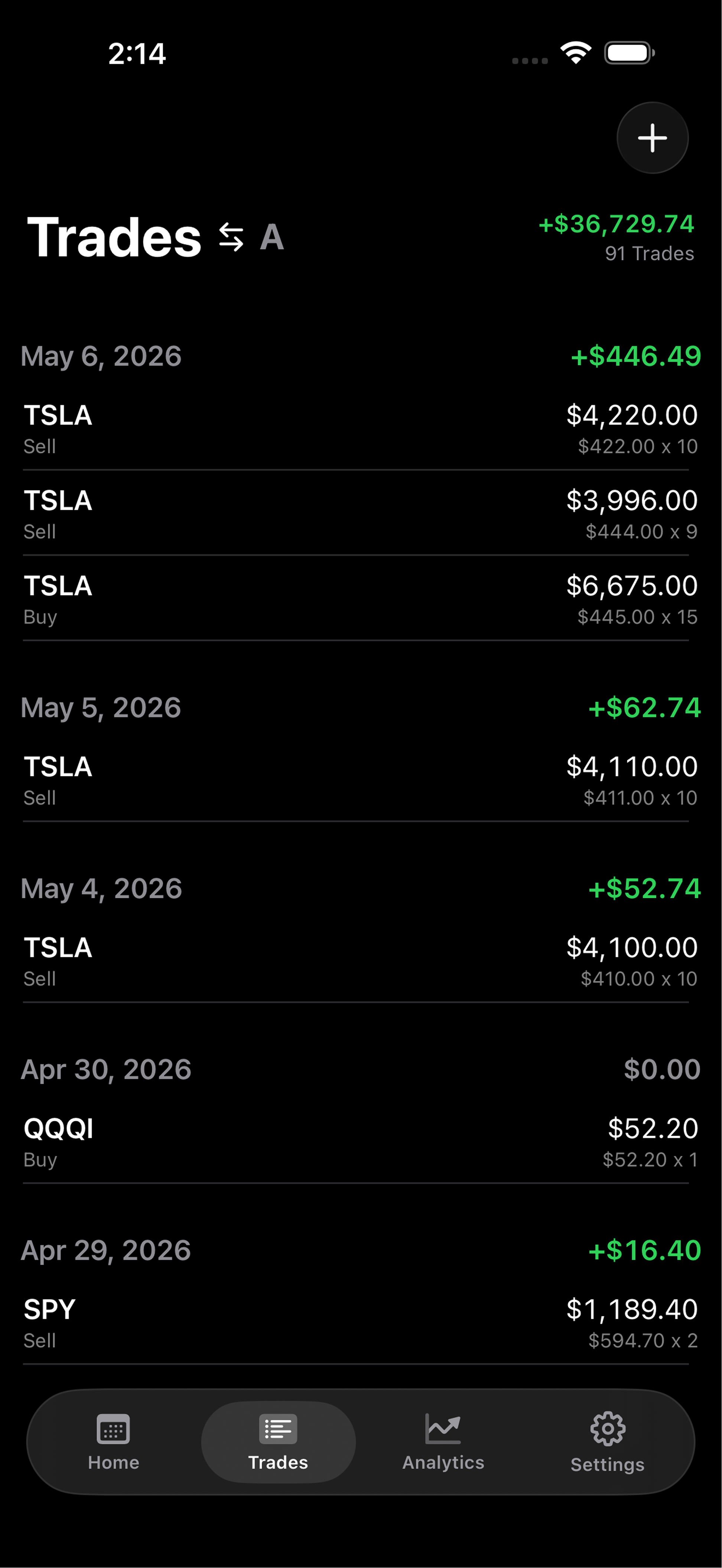
Day - Trading Tracker is intentionally manual. The app is designed around user input because the act of logging a trade forces reflection. You are not just syncing data in the background. You are actively recording your result and taking ownership of the decision.
That extra moment matters. When you type in the trade, the gain or loss, and the details that matter to you, you slow down enough to review your behavior. Was the trade planned? Did you follow your risk rules? Did you exit because the setup failed, or because you got nervous? Did the win come from a repeatable edge, or was it luck?
Automatic data can miss those lessons. A manual journal encourages you to think like a trader who is studying performance, not just checking account history.
Wins and losses both deserve attention
It is easy to study losses because they hurt. A losing trade naturally makes you ask what went wrong. But wins can be just as important to review.
Not every winning trade is good. Sometimes a trade makes money even though the entry was late, the size was too large, or the plan was unclear. If you only judge trades by profit and loss, you may accidentally reward bad behavior.
Not every losing trade is bad either. A clean trade can lose if the market simply does not follow through. If you followed your setup, managed risk, and accepted the stop, that loss might still be part of a healthy strategy.
This is why tracking is so useful. Over time, the app helps you see beyond single outcomes. One trade does not define your strategy. A group of trades reveals your habits.
Day trading improvement depends on pattern recognition, and not only on chart patterns. You need to recognize your own behavioral patterns too. You need to see when you are patient, when you force trades, when you size up too aggressively, and when you cut winners too early.
The calendar view makes consistency visible
Daily results matter because day trading is not only about individual trades. It is also about how you manage a session.
A trader can have a positive first trade and still finish red because they overtraded. Another trader can take one controlled loss and stop for the day, protecting mental capital and account capital. Looking at performance day by day helps you understand your rhythm.
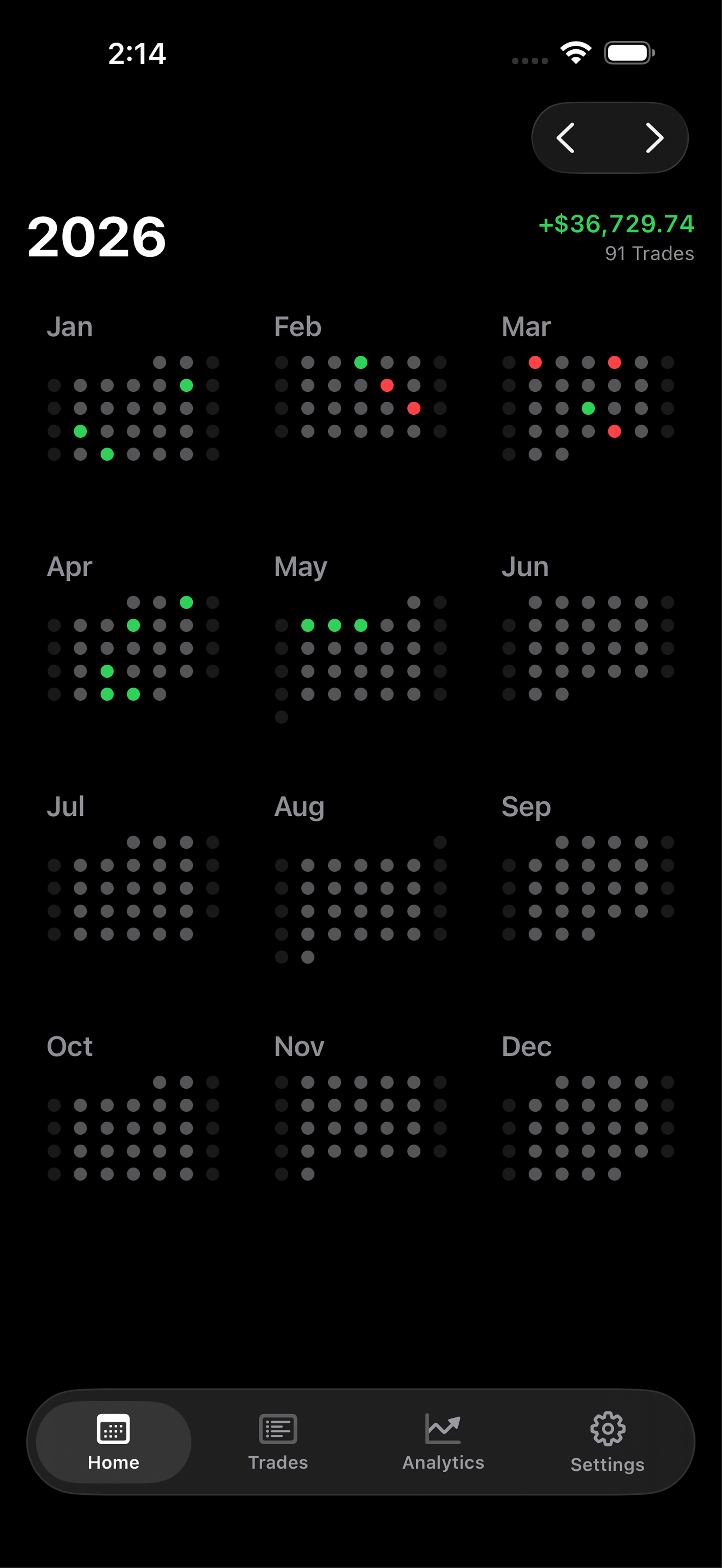
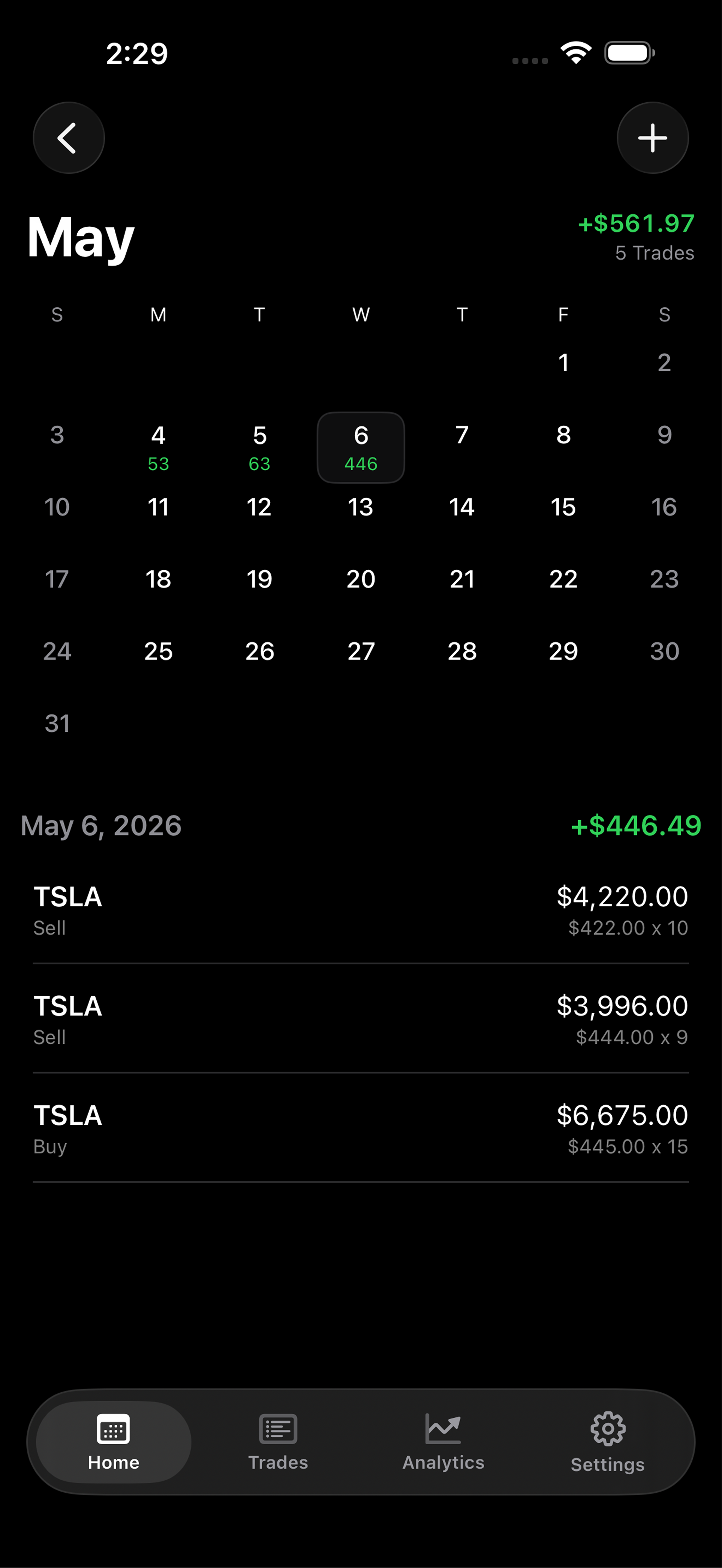
The calendar view in Day - Trading Tracker makes that rhythm easier to see. Instead of digging through scattered notes or brokerage statements, you can review your month at a glance. Green days, red days, and quiet days become part of a bigger story.
This can help you notice trends that would otherwise be easy to miss. Maybe Mondays are strong but Fridays are careless. Maybe you perform best after taking fewer trades. Maybe your worst days happen after a large win because confidence turns into overconfidence.
Those insights are valuable because they point to practical adjustments. The best strategy is not always a new indicator or a new setup. Sometimes the best improvement is a rule like stopping after two losses, reducing size after a big day, or avoiding trades during the first few minutes of volatility.
Analytics turn a journal into feedback
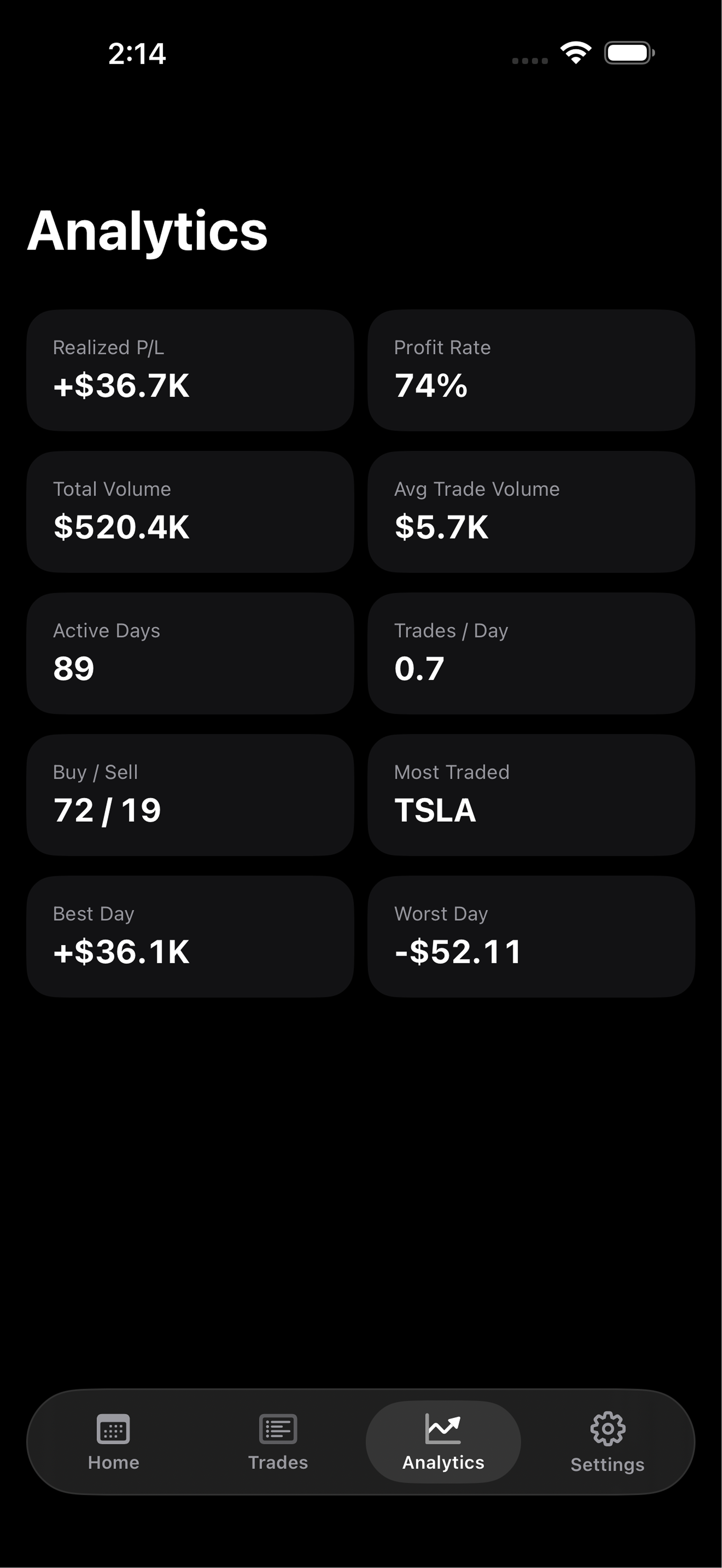
A trading journal is helpful on its own, but analytics make it easier to act on the information. Raw entries tell you what happened. Summaries help you understand what keeps happening.
Day - Trading Tracker is built to help users analyze their own results from the trades they input. That analysis is where real improvement begins. You can look past the noise of one session and start seeing your performance as a system.
Good trading analytics should help you answer questions like:
- Are you profitable because of many small wins, a few large wins, or both?
- Are your losing days larger than your winning days?
- Is your average win big enough compared with your average loss?
- Are you improving month over month?
- Are you following the kind of consistency your strategy requires?
These questions are not about ego. They are about calibration. If your average loss is too large, you may need tighter risk rules. If your win rate is solid but results are inconsistent, your position sizing may need work. If one or two days create most of the damage, you may need stronger daily limits.
The point is not to make trading feel complicated. The point is to make improvement visible.
No brokerage connection means more privacy and control
Brokerage connections can be useful in some tools, but not every trader wants to connect financial accounts to another app. Some users prefer to keep their trading data separate. Some trade across different platforms. Some simply want a lightweight journal without account linking.
Day - Trading Tracker fits that workflow because it does not require brokerage access. You decide what to enter. You decide what matters. The app focuses on the information you provide and helps you understand it.
This also keeps the experience cleaner. The app is not trying to become your brokerage dashboard. It is not trying to replace your trading platform. It is a dedicated tracker for reviewing results, building awareness, and improving decision-making.
For many traders, that separation is healthy. Your brokerage is where execution happens. Your journal is where learning happens.
No subscription keeps the tool aligned with traders
Another important difference is pricing. Many modern tracking apps require subscriptions. That can make a simple habit feel like another recurring expense, especially for traders who are still developing consistency.
Day - Trading Tracker does not require a subscription. That makes it easier to treat tracking as a long-term habit instead of a monthly cost to justify.
This matters because journaling works best when it is consistent. You do not want to start tracking, stop because a trial ended, move to another system, and lose momentum. The value comes from building a long enough history to understand yourself clearly.
A trading tracker should support discipline, not distract from it. No subscription keeps the focus on the habit: log the trades, review the results, adjust the strategy, repeat.
Better strategy comes from honest feedback
Every trader wants a better strategy, but strategy is not only the setup on the chart. Strategy includes risk management, timing, patience, sizing, emotional control, review, and consistency.
Day - Trading Tracker helps with the review part of that process. It gives traders a place to see what is working and what is failing based on their own input. That makes the feedback personal. You are not reading generic advice. You are looking at your own behavior and your own numbers.
That is where real fine tuning happens. If you find that one setup performs best, you can focus more energy there. If you discover that a certain habit creates repeated losses, you can create a rule to reduce it. If your results show that fewer trades lead to better days, you can trade with more selectivity.
Small improvements compound. A better stop rule, a cleaner entry filter, a maximum loss limit, or a habit of reviewing each day can change the way you trade over time.
Build the habit before you need the lesson
The hardest time to start journaling is after a painful losing streak. Emotions are high, confidence is low, and the data may already be incomplete. The best time to build the habit is now, before the lesson becomes expensive.
You do not need a complicated system to begin. Start by logging each trading result. Add the details that matter to your process. Review the week. Review the month. Look for repeated strengths and repeated mistakes.
Day trading will always involve uncertainty. No tracker can remove risk or guarantee profit. But a good tracker can help you become more aware, more disciplined, and more honest about what is really happening.
That is what Day - Trading Tracker is built for: a simple, focused way to record results, analyze your own data, understand successes and failures, and improve your trading strategy without connecting to brokerages or paying for another subscription.
If you want a cleaner way to review your trading performance, you can try Day - Trading Tracker on the App Store.